

Introduction: The Quiet Revolution in Social Work
Social work has always been a deeply human profession — built on empathy, relationships, and a genuine commitment to improving lives. But in 2026, something remarkable is happening beneath the surface of this centuries-old field. Artificial intelligence is quietly transforming how social workers manage cases, identify at-risk clients, document their work, and ultimately deliver better outcomes for the communities they serve.
This is not the robotic takeover that science fiction warned us about. Instead, it is something more nuanced — a powerful collaboration between human compassion and machine intelligence. And for social workers, case managers, and human services professionals who are paying attention, this shift represents one of the biggest opportunities in the history of the profession.
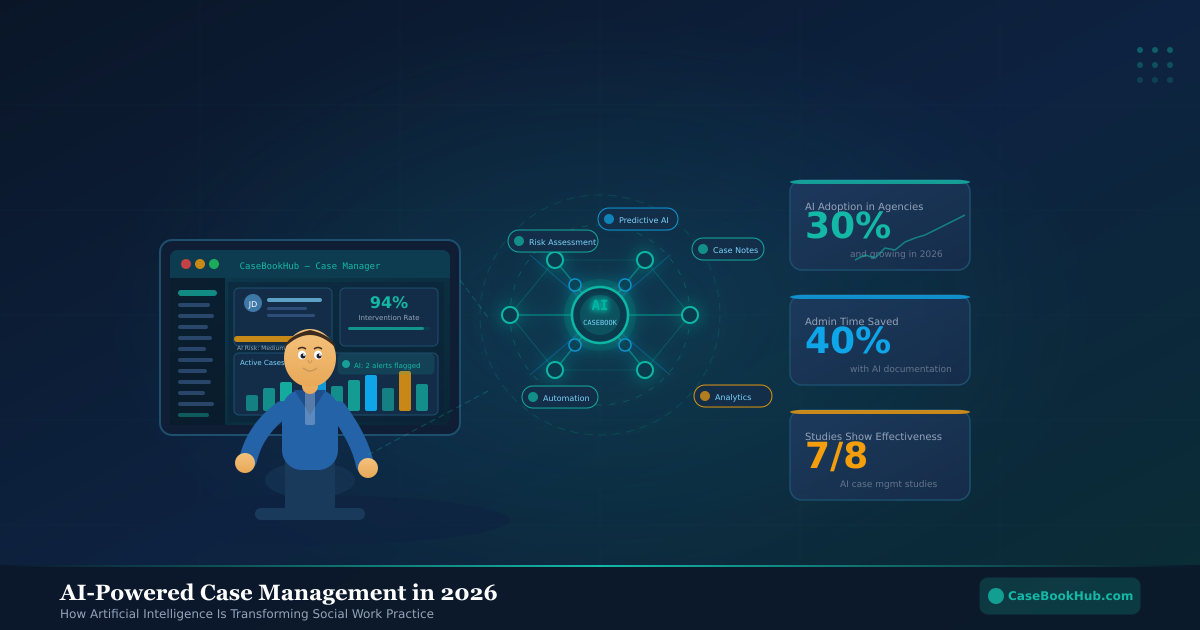
According to Research.com, over 30% of social work agencies have already adopted automation technologies as of 2026, with that number growing rapidly. The World Economic Forum projects that AI-related jobs in health and social assistance will grow by more than 15% annually — meaning the professionals who embrace AI now will be better positioned, not displaced.
In this comprehensive guide, we break down exactly what AI means for social work in 2026: the tools being deployed, the trends reshaping the profession, the ethical challenges that demand careful attention, and the practical skills every social worker needs to thrive in this new landscape.
|
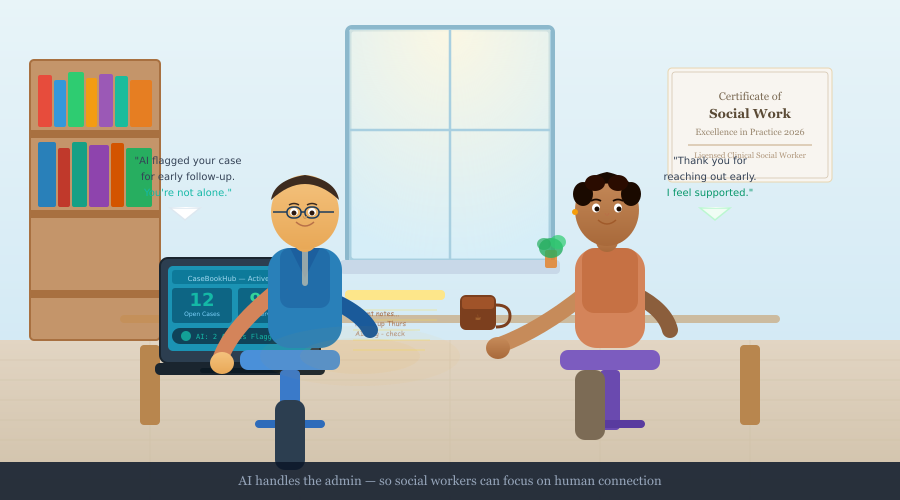
💡 Key Insight AI in social work is not about replacing human connection — it is about eliminating the administrative burden that steals time away from direct client work. When a case manager spends 40% of their day on paperwork, AI gives that time back. |
1. The State of AI in Social Work: 2026 Data You Need to Know
The integration of AI into social work is no longer a future possibility — it is a present-day reality reshaping how agencies operate across the United States and globally. Here is what the data tells us right now:
| Metric | Figure | Source |
| Agencies using automation | 30%+ | Research.com, 2026 |
| AI job growth in human services | 15%+ annually | World Economic Forum |
| Studies showing AI effectiveness in case mgmt | 7 of 8 reviewed | Systematic Review, 2025 |
| Admin time saved with AI tools | Up to 40% | NASW Reports |
| Social workers citing digital fluency as essential | Growing majority | Agents of Change, 2026 |
A landmark systematic review published in 2025, analyzing over 11,022 studies on AI in case management, found that machine learning and natural language processing (NLP) were the most widely deployed techniques. These technologies are being used across five key areas: decision-making procedures, client identification, intervention classification, risk prevention, and service monitoring — and seven out of eight reviewed studies showed effective outcomes.
2. Top 6 Ways AI Is Changing Case Management Right Now
2.1 Automated Documentation and Case Notes
For decades, one of the most persistent complaints among social workers has been the crushing weight of paperwork. Documentation, case notes, progress reports, and compliance forms can consume hours each day — hours that could be spent with clients. AI is now dismantling this burden in meaningful ways.
Tools like Berries, an AI scribe designed specifically for mental health professionals, automatically generates HIPAA-compliant case notes from session recordings. According to the University of Minnesota’s Center for Advanced Studies in Child Welfare, generative AI tools like ChatGPT are now being used to create and generate client notes, develop psychoeducation materials, and produce treatment plan goals — tasks that previously required significant manual effort.
- Case notes generated in seconds rather than hours
- Automatic formatting to SOAP (Subjective, Objective, Assessment, Plan) or DAP formats
- Reduced risk of documentation errors and omissions
- More time for direct client interaction and relationship building
2.2 Predictive Analytics for Early Intervention
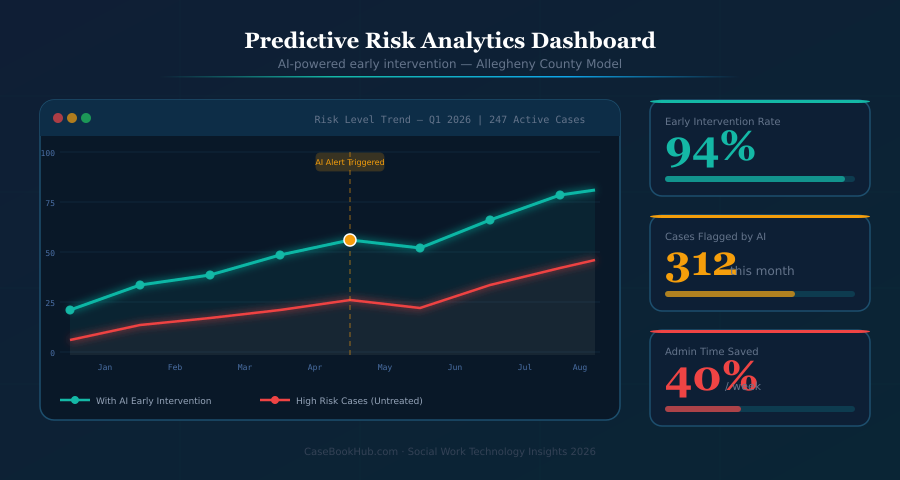
Perhaps the most powerful application of AI in social work is its ability to predict which clients are most at risk before a crisis occurs. This is predictive analytics in action — and it is already saving lives.
One of the most notable real-world implementations is the Allegheny Family Screening Tool (AFST) deployed in Allegheny County, Pennsylvania’s Office of Children, Youth and Families. By leveraging machine learning, the AFST helps child protection hotline workers assess risk and prioritize cases among referred families, enabling earlier intervention and prevention efforts.
|
⚠️ Important Ethical Note Predictive analytics tools like AFST are powerful but not without controversy. Critics have raised concerns about racial bias in algorithmic decision-making, since the data these systems are trained on can reflect historical inequities in the child welfare system. Human oversight is essential — AI should inform decisions, never replace them. |
2.3 AI-Powered Case Management Platforms
Dedicated case management software platforms have evolved significantly, integrating AI capabilities directly into the tools social workers use every day. Leading platforms in 2026 include Casebook, which has built a strong reputation for its HIPAA-compliant, configurable platform designed specifically for human services organizations.
Casebook allows agencies to manage client demographics, track case progress, and improve service outcomes, while streamlining workflows with smart automation, task management, case notes, and comprehensive reporting. Over 85 verified user reviews on platforms like G2 and Capterra consistently highlight its ease of use, customizability, and responsive customer support.
- Centralized client records accessible from any device
- Configurable intake forms tailored to specific program types
- Automated workflow triggers (e.g., scheduled follow-up reminders)
- Real-time dashboards and outcome reporting for grant compliance
- Secure data storage meeting HIPAA, PIPEDA, and other frameworks
2.4 AI Chatbots for Client Support
Access to mental health and social services support has long been limited by geography, office hours, and resource scarcity. AI chatbots are beginning to bridge these gaps in meaningful ways.
Tools like Woebot and Wysa offer AI-powered mental health support, with Wysa specifically using evidence-based cognitive behavioral techniques. These are not replacements for professional social work — but they provide a critical first point of contact, especially for individuals in underserved or rural communities where access to in-person services is limited.
2.5 Location Intelligence and Community Analytics
Social workers have long known that geography matters — where a client lives, the resources available in their community, and the systemic challenges of their neighborhood all shape their outcomes. AI is now enabling a more sophisticated version of this understanding through location intelligence and Geographic Information Systems (GIS).
Case management platforms integrated with GIS tools allow social workers to analyze regional trends, identify communities with concentrated service needs, and allocate resources more efficiently. For instance, predictive mapping can identify zip codes with elevated risk indicators — such as high unemployment combined with food insecurity and housing instability — before individual clients reach a crisis point.
2.6 Streamlined Reporting and Grant Compliance
For nonprofit and government social service agencies, grant reporting is an enormous administrative burden. AI-powered reporting tools are dramatically reducing this burden by automatically aggregating case data into required formats, tracking key performance indicators, and generating compliance reports with minimal manual input.
3. The Top 10 Social Work Trends Driven by AI in 2026
Beyond individual tools, AI is driving broader structural changes across the social work profession. Here are the ten most significant trends shaping the field right now, based on current research and reporting from Agents of Change and NCT Inc.’s 2026 industry analysis:
- Digital Fluency Becomes Non-Negotiable: Digital integration as a baseline expectation
By 2026, digital platforms are central to client care. Social workers are expected to be proficient in case management systems, telehealth tools, and AI-assisted applications — not as optional extras, but as core competencies equivalent to counseling skills.
- Trauma-Informed Care Goes Mainstream: Frameworks embedded in nearly every social work role
Schools, hospitals, and clinics are integrating trauma-sensitive approaches as standard practice. AI tools can help screen for trauma indicators and personalize care plans accordingly.
- Mental Health Crisis Continues: Both a service need and a professional wellness crisis
The global surge in mental health demand is reshaping workloads. AI tools that handle intake screening and routine follow-up are critical for managing this without burning out frontline workers.
- Data-Driven Decision Making: Turning case data into actionable insights
Agencies are using predictive analytics to identify at-risk individuals earlier, personalize care plans, and proactively allocate resources based on patterns in historical data.
- Cultural Humility and Equity in AI: A fundamental imperative, not a specialty
As AI becomes embedded in social work, ensuring that these tools do not perpetuate racial and socioeconomic biases becomes a core professional responsibility.
- Telehealth Expansion: Beyond the office, beyond business hours
AI-enabled telehealth platforms extend services to rural and underserved communities, fundamentally changing the geography of social service access.
- Cybersecurity as a Social Work Skill: Protecting clients and organizations in a digital world
By 2026, social workers need basic digital security training — something historically reserved for IT departments. Client data protection is now a frontline responsibility.
- Emerging AI-Specific Career Paths: AI creates new specialist roles
New positions like AI-Assisted Case Manager, Digital Mental Health Coordinator, and Technology Integration Specialist are appearing in job listings across the sector.
- Client Self-Service Portals: Social service access 24/7
AI-powered portals allow clients to submit documents, check case status, and communicate with their caseworker at any hour — dramatically improving service accessibility.
- NASW’s AI Commission Initiative: Building a professional consensus on responsible use
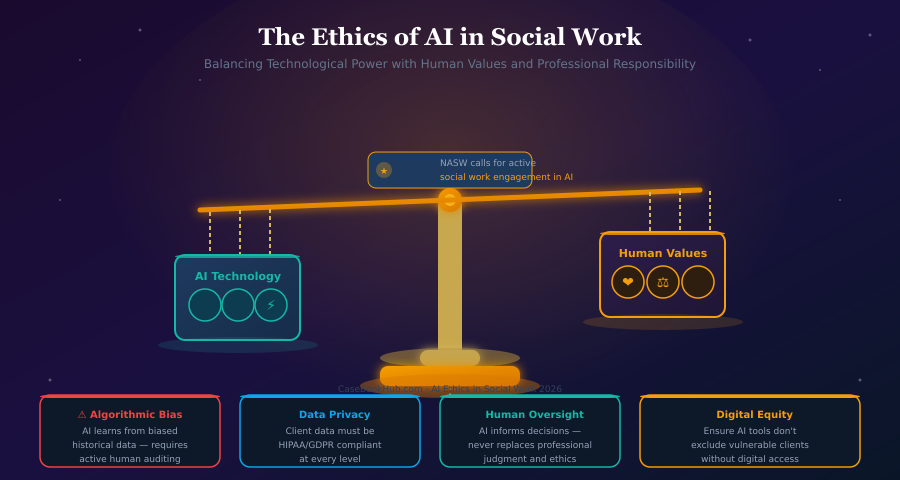
The National Association of Social Workers has called for active engagement from the profession in shaping AI policy, ensuring that social workers — not just technologists — define how AI is used in the field.
4. Ethical Challenges: What Social Workers Must Navigate
The integration of AI into social work is not without significant challenges. For social workers, these are not abstract philosophical debates — they are practical issues that affect real clients and communities. The most pressing ethical concerns in 2026 include:
Bias and Algorithmic Discrimination
AI systems are only as fair as the data they are trained on. Historical data in child welfare, criminal justice, and housing systems often reflects systemic racial and socioeconomic biases. When AI tools are trained on this data, they risk amplifying rather than correcting these inequities. Social workers must understand how the tools they use were built and actively advocate for transparent, bias-audited systems.
Privacy and Data Security
Client information in social work is extraordinarily sensitive — abuse histories, mental health records, immigration status, and more. The move toward AI-integrated, cloud-based systems raises the stakes on data security. Every platform a social work agency adopts must be rigorously evaluated for HIPAA compliance, data encryption standards, and breach response protocols.
The Risk of Over-Reliance
Industry experts consistently emphasize a critical principle: AI should inform decisions, not make them. When a chatbot or predictive tool misinterprets a client’s situation, the consequences can be severe. Social workers must maintain critical thinking and professional judgment, treating AI outputs as one data point among many — never as a definitive answer.
| 📋 NASW’s Position on AI
The National Association of Social Workers has called for social workers to be actively involved in shaping how AI is integrated into the field. As NASW states: ‘The future of social work depends on our engagement and leadership in this transformation. We cannot afford to let AI redefine our profession without our input.’ |
Digital Equity and the Technology Divide
Not all clients have equal access to digital platforms. An over-reliance on app-based services, AI chatbots, and online portals risks leaving behind the most vulnerable populations — elderly clients, those in rural areas without broadband, and individuals experiencing homelessness. Social workers must ensure that technology complements, rather than replaces, in-person service delivery for those who need it most.
5. Essential Skills Every Social Worker Needs for 2026
The social work job market is evolving rapidly. Employers are increasingly looking for professionals who combine traditional social work competencies with a new set of technology-informed skills. Based on current industry analysis from Research.com and Agents of Change, here are the five most important skills to develop:
- Digital Case Management: Proficiency in case management software platforms (Casebook, Apricot, etc.)
- Data Literacy: Understanding what predictive models can and cannot tell you
- AI Ethics Competency: Critically evaluating AI tools for bias, accuracy, and appropriate use
- Telehealth Fluency: Conducting sessions via video, messaging, and AI-assisted platforms
- Cybersecurity Awareness: Understanding data protection laws and basic cybersecurity practices
The good news is that these skills are increasingly accessible through continuing education. The National Association of Social Workers (NASW), the Council on Social Work Education (CSWE), and platforms like Agents of Change Continuing Education offer courses specifically designed for social workers navigating digital transformation.
6. Looking Ahead: The Future of AI-Assisted Case Management
While the present moment is already transformative, the trajectory of AI in social work points toward even more profound changes in the years ahead. Here are the developments most likely to shape the field over the next three to five years:
Real-time Translation and Multilingual Support: AI translation tools embedded in case management platforms will allow social workers to serve clients in their native language without the logistical barriers of scheduling human interpreters.
Generative AI for Treatment Planning: Large language models will increasingly assist in drafting individualized service plans, pulling from evidence-based frameworks and adapting them to client-specific circumstances — while the social worker reviews and approves each recommendation.
Wearable Technology Integration: In healthcare-adjacent social work settings, data from wearables (activity levels, sleep patterns, heart rate variability) will feed into case management platforms to provide a more complete picture of client wellbeing.
AI-Powered Supervision Tools: The systematic review literature notes growing interest in AI applications for social work supervision — tools that can help supervisors identify which cases need urgent attention, track worker caseloads, and support professional development.
| 🚀 Bottom Line for Social Work Professionals
The social workers who will thrive in 2026 and beyond are not those who resist AI, nor those who blindly adopt every new tool. They are the practitioners who engage thoughtfully, advocate for ethical implementation, build their digital skills intentionally, and keep human connection at the center of everything they do. AI is a powerful ally — but you are still the professional that clients need. |
Conclusion
Artificial intelligence is not coming for social work — it is coming to social work, as a partner rather than a replacement. The evidence from 2026 is clear: agencies that thoughtfully integrate AI tools are more efficient, their workers experience less burnout, and their clients receive more personalized, timely, and effective support.
The challenges are real. Algorithmic bias, data privacy, and digital equity require active professional engagement and advocacy. But the opportunity is equally real. For the first time in history, technology can handle the administrative burden that has long prevented social workers from doing their best work — and the result could be a profession that is more effective, more equitable, and more human than ever before.
Whether you are a social work student, an experienced case manager, or a director of a human services agency, now is the time to engage with AI — not passively, but actively. Learn the tools, understand the ethics, advocate for responsible implementation, and help shape the future of a profession that the world needs more than ever.